Cylinder head tube mounting parts: buffer support, centering ring, and washers
001
A very common question with V2 kits and later appears even before assembly: “why does the kit look shorter?”. The answer is simple, but it’s important to understand it properly because it explains how the entire system is secured.
The apparent length does not include a key component: the buffer support. Without this part, the kit looks incomplete; with it, the mounting logic becomes clear.
Why the kit looks shorter than expected
The top section of the kit reserves space for a specific component included in the system: the buffer support. That’s why, when viewed on its own, it may seem like it’s “missing length.” In reality, nothing is missing — the system is designed to be completed with this mounting piece.
What the buffer support is and what it does
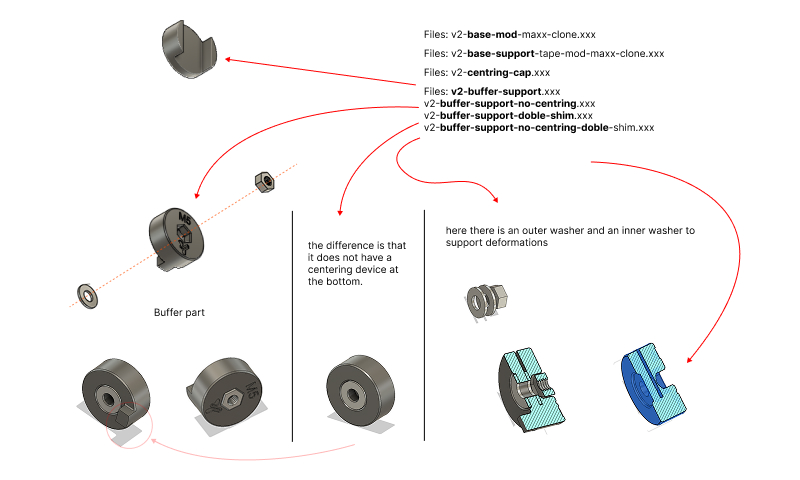
The buffer support is a rounded part with an internal thread. Its function is to hold and secure the stock tube to the replica when screwed into place.
In practical terms: it’s one of the components that makes the system structurally functional. Without it, the stock tube mounting is not properly resolved.
001
Available variants
There are several versions to adapt to different setups.
With centering
Includes a centering feature at the base. This is the most logical option if you want more precise alignment by design.
Without centering (no-centring)
A simplified version without the lower centering element.
With double washer (double-shim)
Includes both an outer and inner washer to reinforce the assembly.
Without centering + double washer
Combines both: no centering feature, but reinforced with double shims.
What shims (washers) are for
This part deserves extra explanation because it has strong practical value. According to the original reference, shimmed versions handle torsion and continuous stress better.
In practice, this means:
- greater resistance to repeated loads
- better load distribution
- reduced fatigue in the mounting area
- a more durable, “all-around” solution
How to choose the right variant
If you prioritize alignment
The centering version is a strong choice.
If you prioritize durability under heavy use
Versions with double shims are especially recommended.
If you want a simpler solution
You can choose a non-centering version, as long as you understand the trade-offs.
Assembly: logical workflow
Although the original content does not detail every step, the process is clearer when approached like this:
- test-fit the kit and confirm the “short length” corresponds to the buffer support space
- identify which variant you have
- install the buffer support in its position
- screw in the stock tube, ensuring clean threading (no cross-threading)
- add shims or washers depending on the version
- check alignment, rigidity, and absence of unwanted play
What to check after assembly
- the stock tube is firmly secured
- no unusual torsion when handling the stock
- the system is fully engaged (not partially assembled)
- the buffer support is properly seated and not under stress
Common mistakes
Thinking the kit is missing a part
In most cases, nothing is missing — the buffer support simply hasn’t been accounted for.
Not distinguishing between variants
Installing without knowing whether you have centering, non-centering, or shimmed versions leads to confusion later.
Underestimating shims
They are not decorative — they provide real reinforcement against torsion and stress.
Quick troubleshooting
The setup feels less solid than expected
Check if you should be using a shimmed version or if the assembly lacks proper tension.
There is torsion in the stock tube
Verify shim presence and correct seating of the buffer support.
It still looks short after assembly
Confirm the mounting part matches the correct kit version and that no hardware is missing.
Quick FAQ
Why does the kit look shorter?
Because part of the functional length is provided by the buffer support.
What does the buffer support do?
It secures the stock tube using its internal thread.
What is the benefit of shims?
They improve resistance to torsion and continuous stress.
Which version is best for heavy use?
Shimmed or double-shim versions are the best choice for durability.
Final note
This is a good example of a small part that seems secondary until you realize it actually defines the entire mounting system. The buffer support is not optional — it’s part of the kit’s core logic. And the different variants (centering, shims) are not minor details, but real functional decisions. :contentReference[oaicite:0]{index=0}