First M4 lower made of pressed carbon fiber: experiment, weight, and lessons learned
001
002
First M4 lower in pressed carbon: experiment, weight, and lessons learned
001
Model created on: January 14, 2024
Not every advancement comes from a perfect plan. Sometimes it comes from leftover material, a spontaneous idea, and the curiosity to see how far a process can go. That’s exactly what happened with this pressed carbon M4 lower: a quick, unconventional experiment that mainly served to understand what works, what doesn’t, and what should be improved in the next iteration.
Rather than a finished product, this piece should be seen as a development prototype: a serious test of weight, structural feasibility, and manufacturing process.
Where the idea came from
The project started while working on other pressed carbon parts. There were leftover scraps, fibers, and cuttings that had already been used to make an inner barrel and an M4 stock. The logical next step was to ask whether the same approach could scale into something much more ambitious: a full M4 lower receiver.
The short answer: yes, it can be attempted. The useful answer: yes, but the process has very clear critical points.
Prototype approach
According to the original content, the 3D model was prepared very quickly and filled with epoxy resin, with inserts added to allow the grip to be mounted. This means it wasn’t just about making something visually interesting — it was about testing whether the part could meet basic functional requirements.
Key elements of the experiment
- 3D model prepared for pressing
- use of epoxy resin to consolidate the structure
- integration of inserts for grip mounting
- clear goal: reduce weight without losing too much rigidity
On paper, the concept made sense: a pressed carbon lower could offer a compelling mix of low weight, distinctive aesthetics, and sufficient rigidity for certain applications.
The critical moment: demolding
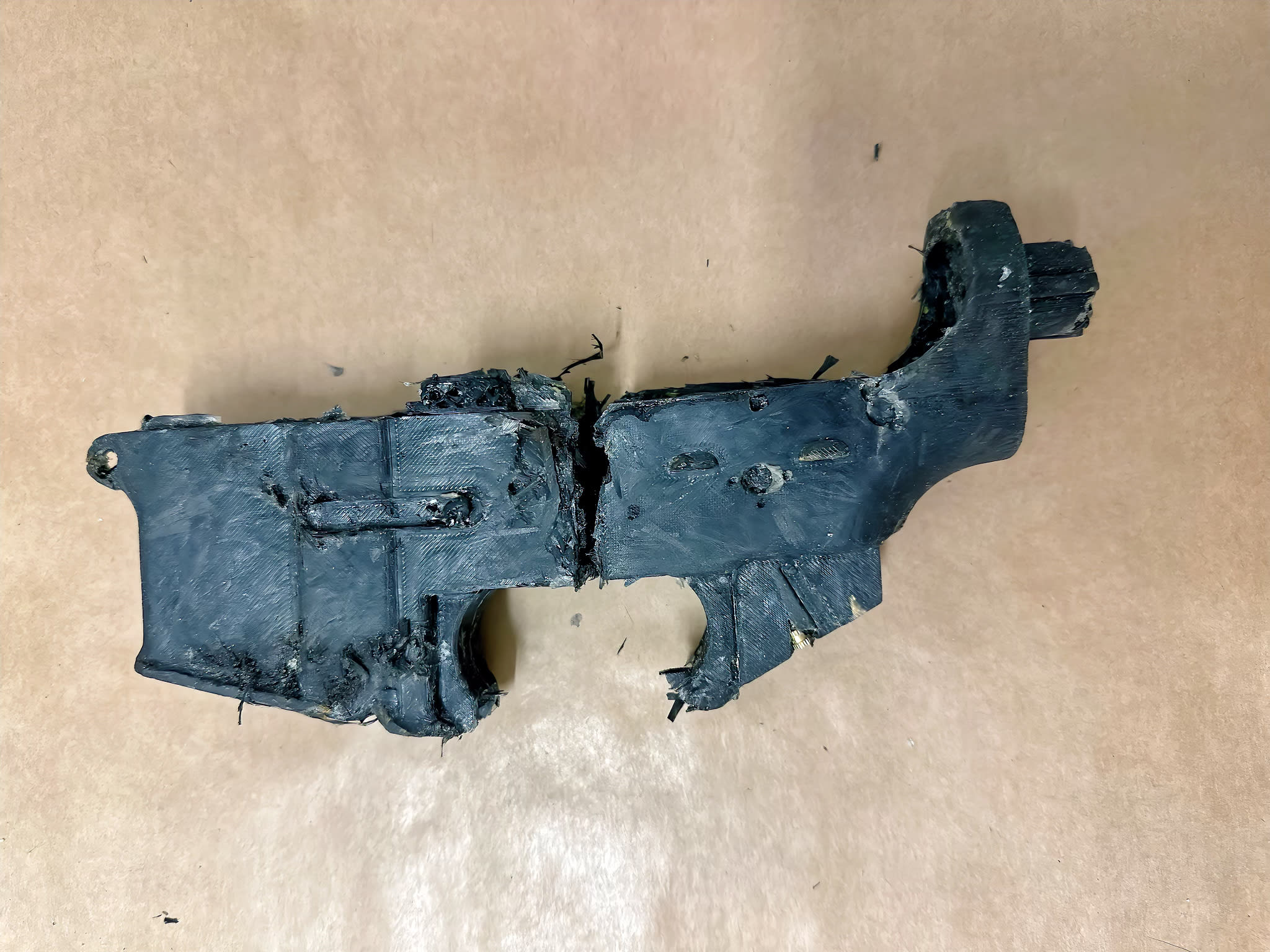
The initial result was promising, but the key moment appeared where most composite projects are decided: demolding. In this case, the part was left too long before removal, and when extracted, it broke unintentionally.
At first glance, this may seem like a failure. In reality, it isn’t. With composite materials, the process matters as much as the design — sometimes even more. Knowing the part holds up to a certain point and fails during demolding is valuable insight for the next iteration.
Weight comparison
One of the most interesting outcomes is the weight:
- Original plastic part with split gearbox: 127 g
- Pressed carbon prototype: 120.7 g
The reduction is not massive, but it’s significant for a first attempt. The original analysis highlights an important point: optimizing wall thickness and internal cavities could reduce weight even further.
What worked well
Even though the prototype broke during demolding, it provided several positive conclusions:
1. Pressed carbon is viable as a structural base
It’s not a far-fetched material choice. In fact, it makes sense when aiming for a lightweight solution with a unique identity.
2. Epoxy resin effectively consolidates the structure
The epoxy wasn’t just cosmetic filler — it played a structural role, and the test suggests this approach works.
3. Inserts add real functionality
Being able to mount the grip with inserts shows the project went beyond a simple concept model. There was a clear intention to make it usable.
What failed or needs improvement
Demolding timing
This was the most critical factor. In composite materials, removing too early can deform the part, but removing too late can ruin it. The takeaway is clear: the process needs a more controlled timing window.
Design for manufacturing
A model that works for shaping doesn’t always work for manufacturing, demolding, and repeatability. A future version should consider:
- draft angles
- resin accumulation zones
- wall thickness
- stress points during extraction
- overall mold strategy
Project objective
If the goal is weight reduction, the design should be more aggressively optimized. If the goal is strength, material distribution must change. A future iteration should define priorities more clearly.
What this prototype teaches
This type of content is valuable because it’s honest. It doesn’t claim perfection — it shows what was tested, what worked, and what needs improvement. For a technical brand like Sychev Lab, this reinforces an important idea: development is based on real testing, not empty claims.
Is there room for a second version?
Yes — and quite a lot. The results suggest room to:
- further reduce weight
- improve mold release
- optimize internal geometry
- turn an interesting prototype into a serious product
A properly refined second version could represent a clear step forward.
002
Quick FAQ
Was this a finished, ready-to-use part?
No. It was clearly a first experiment and a proof of concept.
Is the weight reduction worth it?
For a first iteration, yes — it’s a positive indicator with room for improvement.
What was the main issue?
Demolding. Not the material concept, but the timing and process of extraction.
Does pressed carbon make sense for airsoft?
Yes. This prototype suggests the concept is viable, provided the process is refined.
Conclusion
This pressed carbon M4 lower was not a finished product, but it was a valuable test. It proved that the material makes sense, that weight can already be reduced compared to stock parts, and that inserts and epoxy allow for functional — not just aesthetic — solutions.
What was missing was not the idea, but a second iteration of the process: better design for manufacturing, better demolding control, and more internal optimization. And in real development, that’s exactly the kind of learning worth sharing.
If you’re interested in lightweight parts, pressed carbon, or unconventional M4/AR15 developments, this project provides a solid starting point. And if Sychev Lab revisits the concept, a truly refined version could emerge.
Visual reference: https://www.youtube.com/watch?v=HtRb-vvZlIQ
Related products
Explore these designs from the same topic: